the pros of working in a school with no equipment or how I developed my interest in Dogme

In the school where I work now there aren't any projectors, there is one laptop for all the teachers, there are basically no textbooks, the rooms are rather small and often the teacher has to use blackboard and chalk because there are no markers to be used on the whiteboard (the whiteboard doubles as blackboard on the flip side); often, for at least half of the month, Internet doesn't work and many days the electricity comes and goes. There is no staff room either and teachers are expected to sit next to the only printer to do their printing, in a busy passage between the reception and the stairs (there are no copiers, only this one very inefficient multi functional printer which is mostly used as copier, and I'm only waiting for the time, very soon, when it will collapse under the work load).
In this context, I suddenly developed a keen interest for everything Dogme, since my lessons, whether I like it or not, have to follow most of its principles, namely:

Resources should be provided by the students or whatever you come across. If doing a lesson on books then go to the library.
All listening material should be student produced.
The teacher should always put himself at the level of the students.
All language used should be 'real' language and so have a communicative purpose.
Grammar work should arise naturally during the lesson and should not be the driving force behind it.
Students should not be placed into different level groups.

From teachingenglish.org.uk

 
To this, I should add that most of the hours I teach are focused on preparing teenagers for exams, something which, on one side, makes everything more difficult, since I am expected to input some exam material which needs to be printed and does not really have a relevant interest for the student, thus breaking one or two of the Dogme principles -- but on the other perfectly abides by its rules because it places the direct study of grammar out of the classroom.
All considered, I am quite intrigued by Dogme right now. Long ago I made mine the principle that the teacher does not blame a bad lesson on the equipment -- and I stick by it. I just make do, like all the other teachers here, locals who don't even expect things to be different (though they seem to strangely manage by enforcing a "traditional" school discipline i.e. students stand up when the teacher enters and teachers are addressed as "mister" and "miss", something that to their bafflement I refuse to comply with).
So everyday I face the tragic challenge of having to come up with an interesting lesson without using any textbooks, without diving into any of my faithful ActivInspire flipcharts, without preparing sets of images on Google, without playing videos or opening books at page x. At first I resented having to chunk my personal trove of accumulated, created and adapted material. I leave examples of  one or two dogme-style classes to a following post.

the metric mermaid greenboard of the day

img_20161012_145628
There is an activity I do with kids (8-11) on my first lesson, which ultimately focuses on them drawing on a piece of paper a self-portrait, with the things they like, and answering to simple questions such as "what's your name?" and "what's your favourite toy?"
However one of the questions on the piece of paper is: "how tall are you?", which of course kids for the most part cannot answer.
Hence what you see on the "greenboard of the day": one by one the kids come to the board and I measure their height. I use a short classroom ruler, of maybe 30 centimeters, and a lot of addictions and subtractions, which I ask the students to calculate in my place.
At the end, when we finally have moved to the presentation of the next activity, the students have practiced numbers, calculations, the metric system... while enjoying a bit of celebrity status in coming to the board and having their name written on it, proof of the complicity between them and the teacher.
Naturally there is also a secret purpose to this, which is allowing yours truly, the teacher, to learn at least some of the names of the students on the first day.
When two of them are the same height I put them back to back and we all decide whether they're really the same height... what's most amazing to me is that never in this activity I've witnessed the slightest hint at competition to "be the tallest".
As to the mermaid and the name of the the local teacher above it... they're leftovers of the following activity and of the copious drawing it involved.

excerpt from a letter to my friend P. who is a human being and therefore surprised I might want to take DELTA next year


...as for the DELTA, I see where you're coming from, but you are thinking of IH and their disgusting corporate structure (I don't think I will work for IH ever again), but around the world it does not necessarily equate being 'management', who says that?? At most DELTA for me would mean being a trainer somewhere, other than a teacher, and I don't see anything wrong with that. If I can pretend to be one, I can pretend to be the other as well.
Bottom line, you should see my mailbox, because as a native speaker you might not get the full experience of how hard it can be to get a job anywhere in this trade. You would find hundreds of applications I've sent all over the world in the past three years which never even received an answer. Many to my home country. To British Council alone there are more than 30, though to be fair I always get their rejection emails, which I know by heart by now. When I do receive an answer it is often because there is some disgusting little aspect to that job that makes it unpalatable to most of the native speakers.
Sure I'd be happy to do anything else in life (I've had a lot of jobs and no qualms in starting over) but to be honest this is the grind that gave me the most stability with the least necessity to suck up to anybody, so I might try to beat this dead horse a while longer.
J.

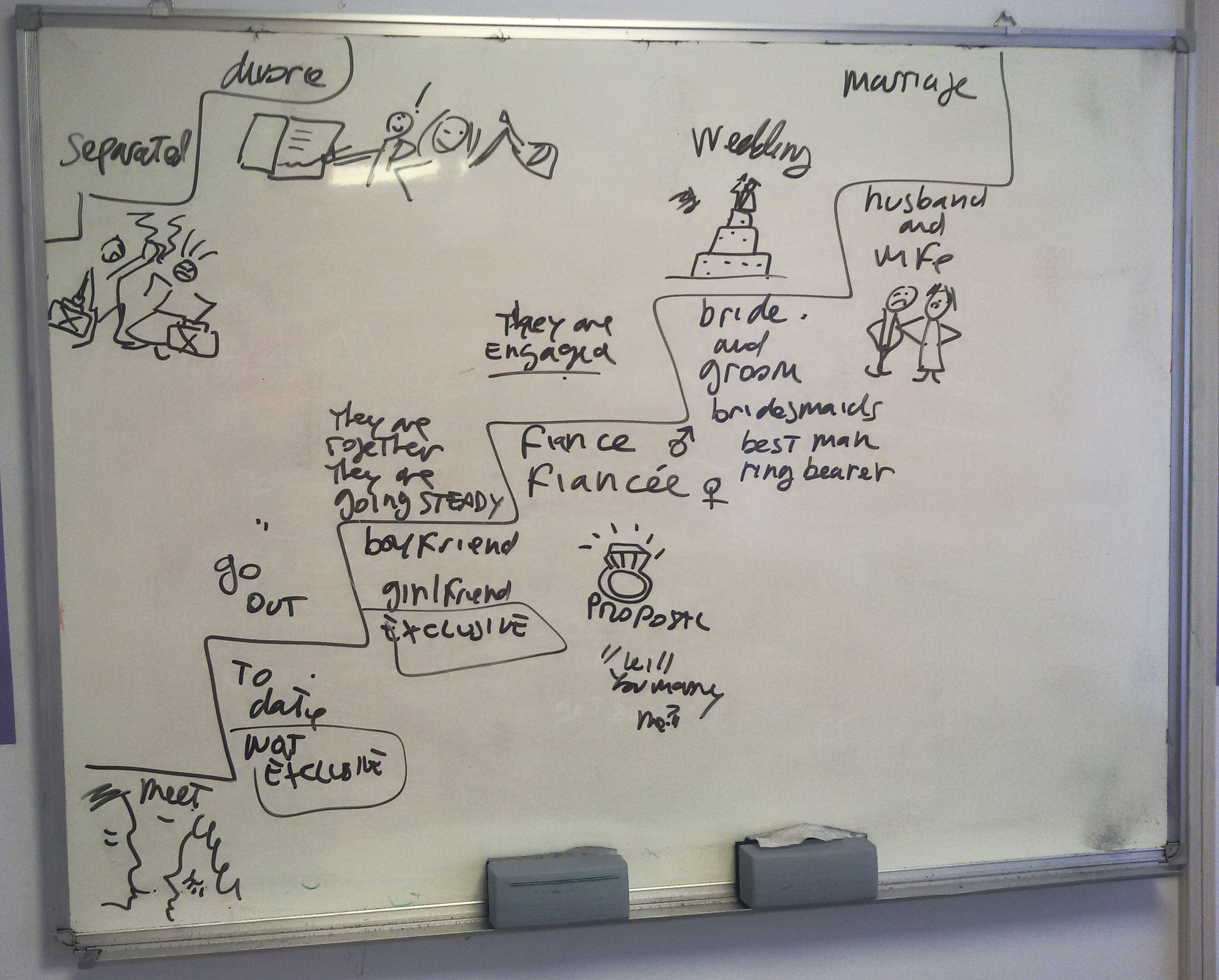
steps in a relationship whiteboard of the day

img_20151126_154411
I'm sure not unlike many other teachers, I've drawn this a few times in class and it's always proved productive. At least is seems that this visual idea and the vocabulary in it are easily remembered.
Only once in my experience the addition about separation and divorce backfired, after I ventured those smiley faces on the celebrating divorcees' faces and made a couple of silly comments. This cooled off my small executive group rather awkwardly. To everyone's knowledge except mine, one of the members of the class was going through an unpleasant divorce.
Just a reminder a teacher should know enough about their students before venturing in such territory.

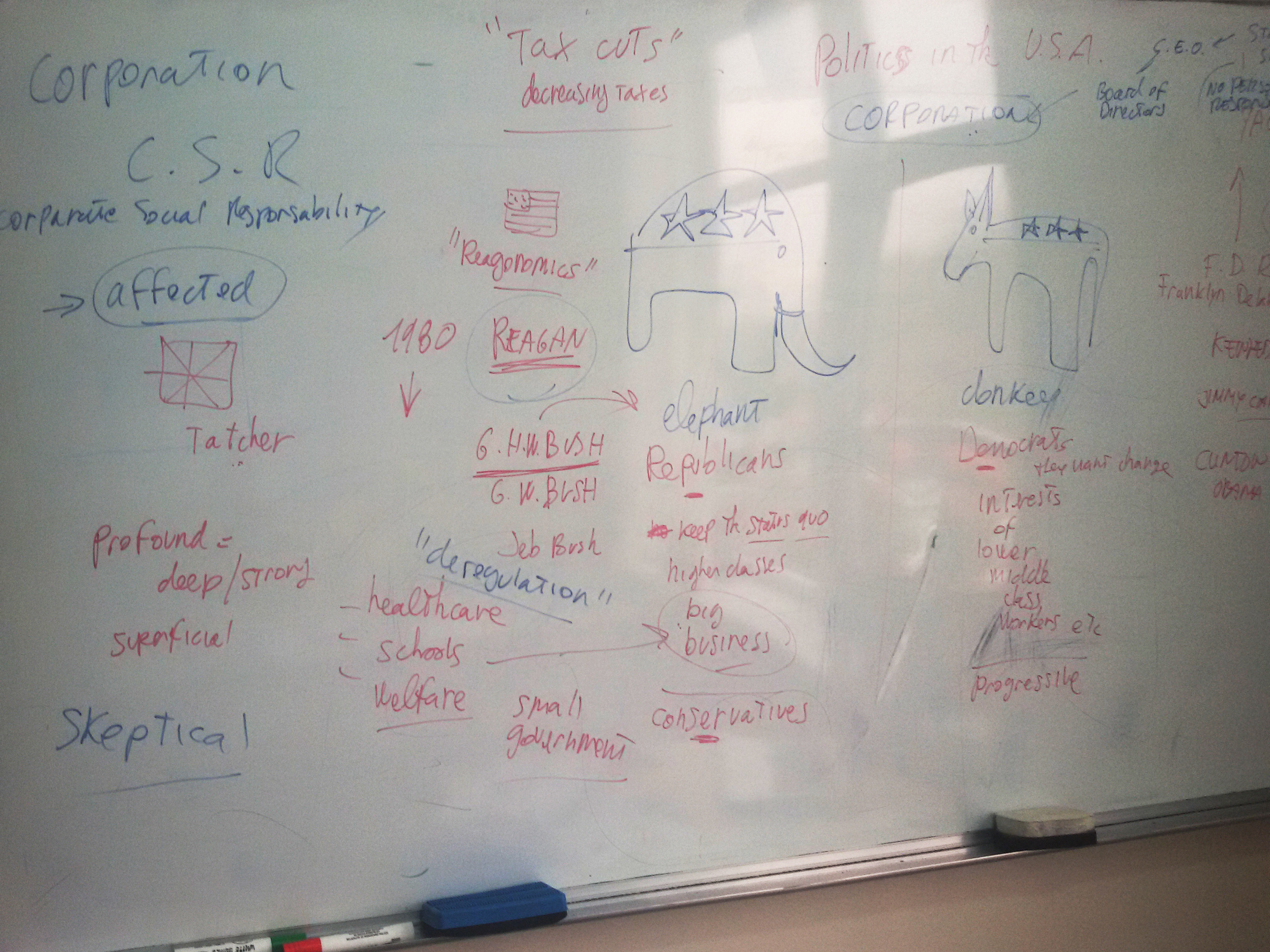
the American politics in class whiteboard of the day

The first time I expounded the topic (as a spin off intro to a Business lesson on Corporate Social Responsibility), I thought I would start from the elephant and the donkey. If anything, should the topic raise zero interest, this would qualify as an impromptu refurbishing of animal vocabulary.
Instead, as you can see, we went quite further, getting stranded somewhere between Reaganomics and Jimmy Carter.img_20151016_094247
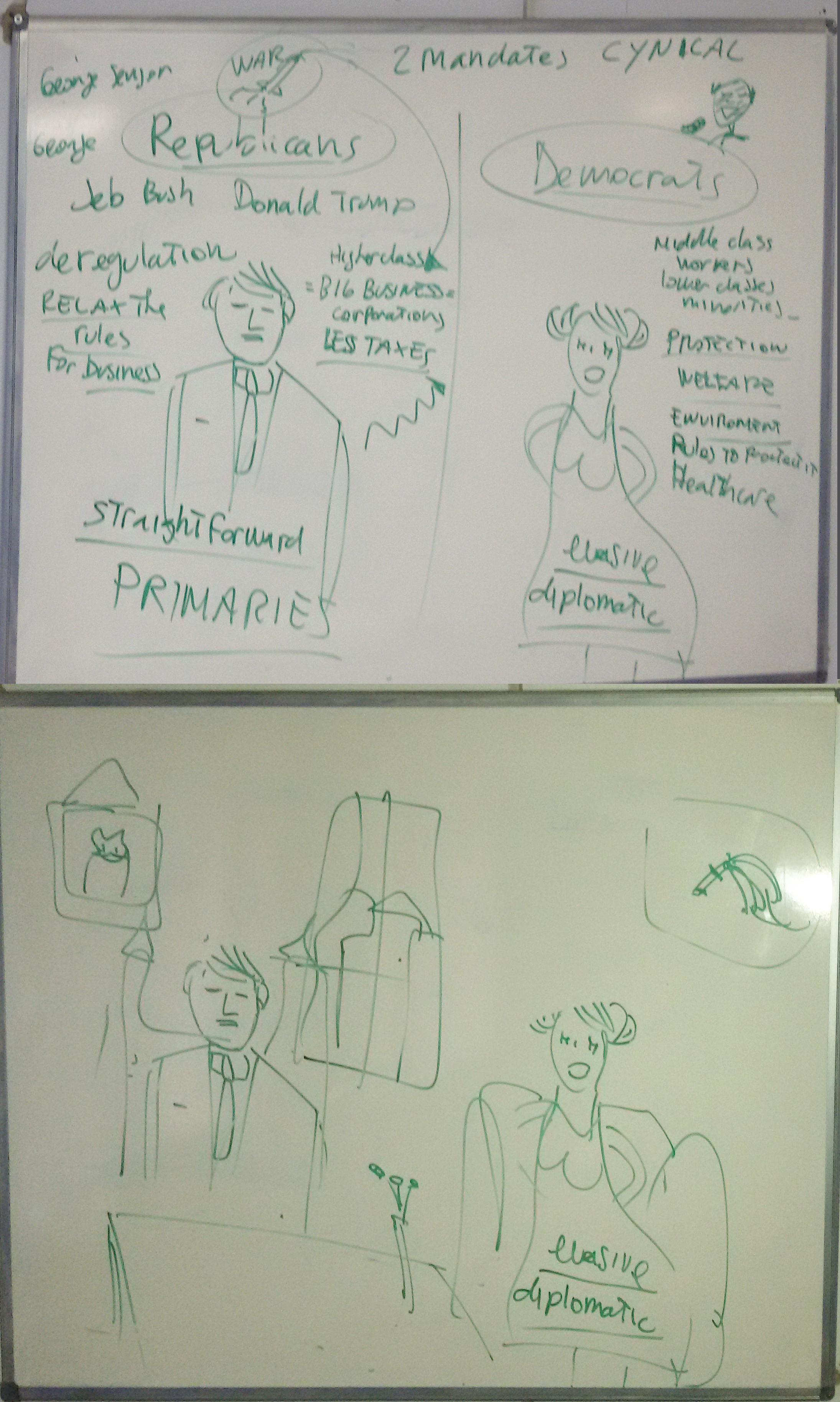
In another lesson the same topic came up, but this time I started from an attempt to portrait the candidates, asking the students to identify them as I drew them. Trump's hair did it, if I remember correctly.
* The vocabulary you see around the characters below is the result of a few minutes of collective eliciting and sharing of ideas, and does not constitute representation of the teacher's political mind.img_20151228_165205
Afterwards almost everything was deleted, leaving only the two characters who at this point became just another husband and wife in a dreary living room. This allowed me to move on to another subject, "language to describe pictures", not after having elicited more vocabulary to describe the quality and color of such marriage, once established as a starting point that, not unlike a political candidate, the wife here appears to be "evasive" and "diplomatic".

Do you like fish sticks? how we could use a totally inappropriate South Park joke in class

If we were allowed to use coarse language, inappropriate jokes and nonsensical or absurd comedy in class, this South Park episode would be ideal to give an example of the trickery of pronunciation and collision of words.
southpark-gayfish
It goes like this:
do you like /fɪʃtɪks/?
do you like putting /fɪʃtɪks/ in your mouth?
what are you, a gay fish?
The trick is all in that /t/ that ends up sounding a bit soft due to the rushed way in which we name and identify this particular product.
The above could serve as a jocular introduction to a couple of pronunciation games emphasizing how we really say words in English, and how these words are never in isolation but actually mashed together head to tail... something like the teacher reading out different pronunciations of different phrases, as the students match them to transcript; or teacher giving red and white squares of paper to be placed according to the stress in a phrase or sentence.
(of course, as wikipedia tell us, fish sticks are really fish fingers, as they were called when they were first invented in Britain. To which could follow a discussion on how some jokes can only be validated locally).
 

eliciting vocabulary note to self

when you write a word on the board and elicit vocabulary (for example: "childhood") or show pictures to the same effect - try going one by one, asking them to say all the words they can think of, rather than eliciting from the group as a whole, which seems fun but goes by very fast.
-- Togzhan?
well... school, games, friends...
-- Aziza?
toys... sleep
-- Aikunim?
I want to say ice cream, grandma, school...
-- Oxana?
hmm... poo?
etc

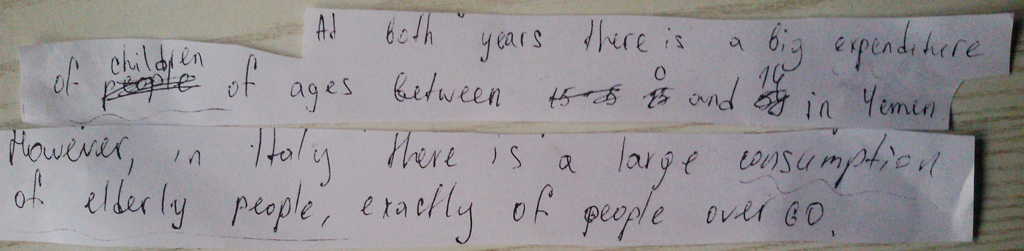
a big expenditure of children and a large consumption of elderly people, continued part two of my IELTS rant

[continued from the first part]
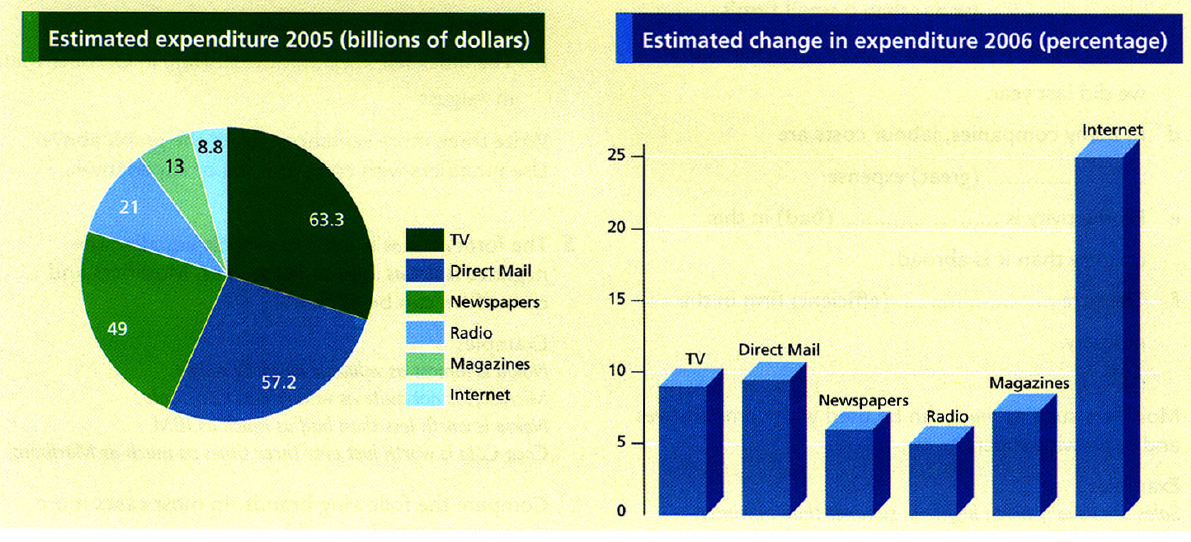
So one day we looked at this (from the book IELTS Masterclass):
charts
The charts illustrates spending on advertising across different media sources, so the emphasis was about numbers to express expenditure, proportions, preference, etc.
After a bit of vocabulary clarification, and a few sentence samples, the students were put into groups and given one of the charts, for which they had to provide the best possible written description. The groups were then mixed and the charts compared verbally. After a bit of feedback the students were given 12! minutes (not 20, because the thinking had already been done, and also because this class had the tendency to write too much) to actually write the task. So far so good, although of course they don't like this task. Nobody does. The results aren't exciting no matter how much craft you possess.
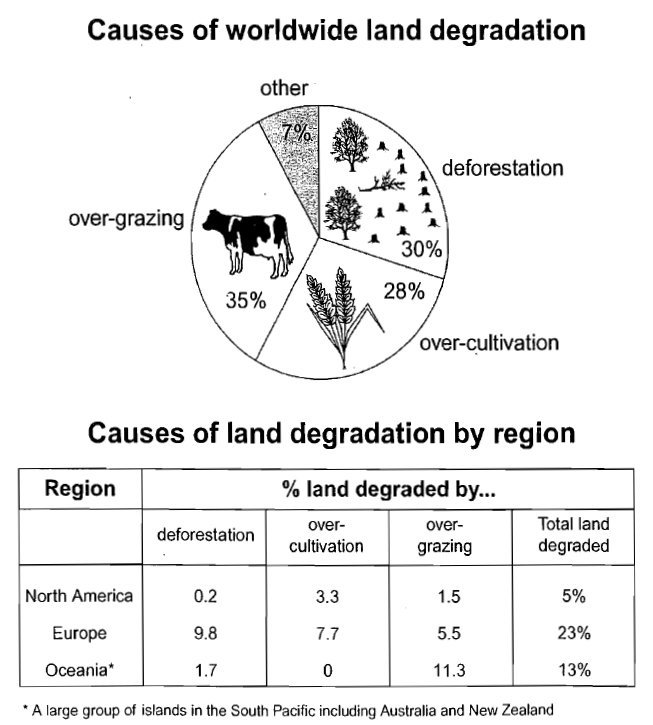
Another day, a different chart. This time from Cambridge IELTS 8:
charts2
We focused this time on consumption, degradation, eating habits, overuse etc.
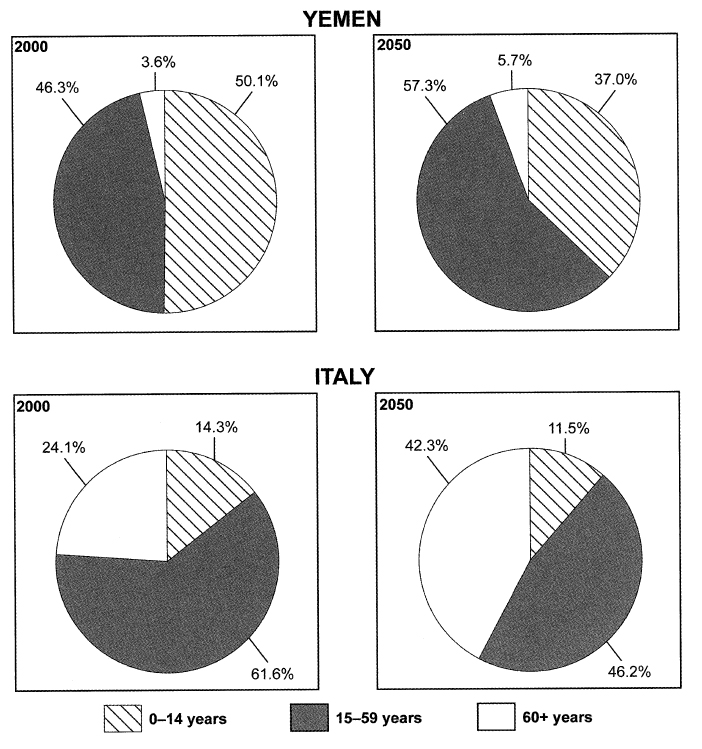
Another day, it was this set of charts, from IELTS 9:
charts3
Even without including the task instructions, it appears evident that these charts are describing age groups in two different countries. However, because we teach the IELTS exam, but we have no time to actually teach why charts such as these exist, when and how they are used etcetera, they are perceived by some students as mostly sadistic ways to test the students' understanding of numbers inside and around differently shaped graphs, despite the graphs actually having no meaning of their own.
It is not always easy or obvious to make the students think differently, and the results can be sometimes discouraging or hilarious, depending on your outlook on that particular day. So this was the result after our time spent on writing task 1 (right from my locker where I keep the trophies):
expenditure2

a big expenditure of children and a large consumption of elderly people AKA my IELTS rant

Teaching IELTS rather than teaching English is ultimately a contradiction. This exam tests the level of English after all, and the student's ability to use it in a purposeful way; just learning the test format inside out seems to be a desperate, uncool way of cheating -- yet we make the whole experience into exactly this, a test about the test itself and our understanding of the different parts of the test and our feelings on the day of the test and this is how we pass the IELTS test, voilà.
Maybe this happens because the IELTS format is so eternally rigid and presents no surprises. It is a bit like working out, doing always the same sets everyday. Every trainer will tell you that this does not improve your fitness, because the muscles will do their best to save energy once they have memory of the tasks that await them: you've got to "fool" your muscles if you want them to become stronger. Feeling that your exercises come easier and easier is not a good thing either. Basically you're still weak, but you're in shape enough to do the exercise (that Senifeld bit coming to mind).
Especially the so called "IELTS Foundation" class is a bit of a joke, its only purpose being the business need to catch delusional students who otherwise would roam towards other schools. There shouldn't be an IELTS Foundation class. Instead, the hopes of the students should be crushed for their own good, and they should be sent to a good General English class to do some time. Although, the class has a purpose for the student too, because at that stage they usually need someone to blame for not entering that University, and your local English school will just do.
Of course it's crucial for the students to know how the exam works, but as a teacher you cannot help but feeling that this should happen within a larger context where English learning and exposure to English culture are the real focus of your time with the students. More importantly, there should be a context in where students learn to use their imagination critically. Soon they will face an examiner and will have to discuss intelligently how the Internet has changed relationships, or what role will pets play in the future; why people cannot stop using cars or why food is the last remaining bit of national culture left, which is why we are all so ridiculously attached to it. That subconscious, instantaneous, defensive answer "what do I know, I'm barely out of High School" will most definitely not cut it.
Instead even your average IELTS "Masterclass" group (no name was more inappropriate, since it gives the student the illusion of being part of a specially selected bunch of next-to-be IELTS wizards) is made of students with little or no experience in using English in real life, let alone in an academic context, who only have two or three months to get into that University and have exactly the right amount of desperation to get their thinking all fogged.
The web is full of tips and a large industry of book publishing thrives on this. Yet the so called "exam techniques" are often very arbitrary in that they focus on aspects that can be obvious for one student, unheard of for another, and which can seriously hinder candidates who have their own personal or even creative way of looking at a task. Sometimes they are offensively disingenuous, for example when they pretend to teach the student how to "listen for the answer" in an IELTS listening by considering the stress, or the appearance of certain keywords. A confusing waste of time.
What will you teach them then, in those three "intensive" months?
What you do, once they are familiarized with the format, is for the most part to give them vocabulary sets and interesting ways to practice them, help them to organize their writing and speech and, ultimately, do quite a bit of IELTS practice in class, since you know they will not do it at home as they should. No, there will be no Eureka moment to look forward to.
It's not the best premise for good teaching. However as a teacher you do it and of course, as with everything, useful things can come out of it. Which brings me to the title of this IELTS post.
[continues in the second part]
 

“what will I teach today?”
an ESL blog by
© 2026