the Writing Robot short story of a failed romantic activity.

    "Please don't do your best. Trying to do your best is trying to be better than you are."
~ Keith Johnstone

 
I first read the name of Keith Johnstone in the very useful, quite inspiring book "Lesson from nothing" by Bruce Marsland.
I got curious about Johnston and soon bought his "Impro: Improvisation and the theatre", even though in my life I've always stayed away from stages and theaters and performances in general...
If you don't know anything about him, you can start from his recent TED apparition:

Since reading Johnstone's book, I tried to appropriate some of the games and activities it describes, especially in the part of Impro where Johnstone discusses his experience as a school teacher, before getting into theater.
Some of these became a recurrent traveling game between me and my wife, such as telling short stories together one word at a time (there's always a pigeon in there, for some reason). What's strange is that I've almost never had the courage to try any these things in class. Or, if I have, the memory of it has been quickly erased from my mind with a shudder.
I tell myself that it's hard to find that atmosphere of openness and active imagination among adults who are paying your lessons very dearly, or among kids who have been parked there by their busy parents.
One activity I remember doing, with a beloved small class of teenagers I had for two or three semesters a couple of years ago and with whom the atmosphere was so good I probably felt I could try really new things, was "The Writing Robot". Johnstone did something like this with a typewriter he brought to class, giving his students art pictures as an inspiration.

One day I took my typewriter and my art books into the class, and said I'd type out anything they wanted to write about the pictures. As an afterthought, I said I'd also type out their dreams... I typed out everything exactly as they wrote it, including the spelling mistakes, until they caught me. Typing out spelling mistakes was a weird idea in the early fifties (and probably now)—but it worked.
Keith Johnstone, Impro

 
These are the first mistakes I made, because my robot wrote on the board in my ugly handwriting, and there were no pictures to take the first stories from. That's because I didn't remember that part of the book. But there's more mistakes.
Another one was that I over-prepared for something that should have been spontaneous. Here's the first slide I presented to the class:
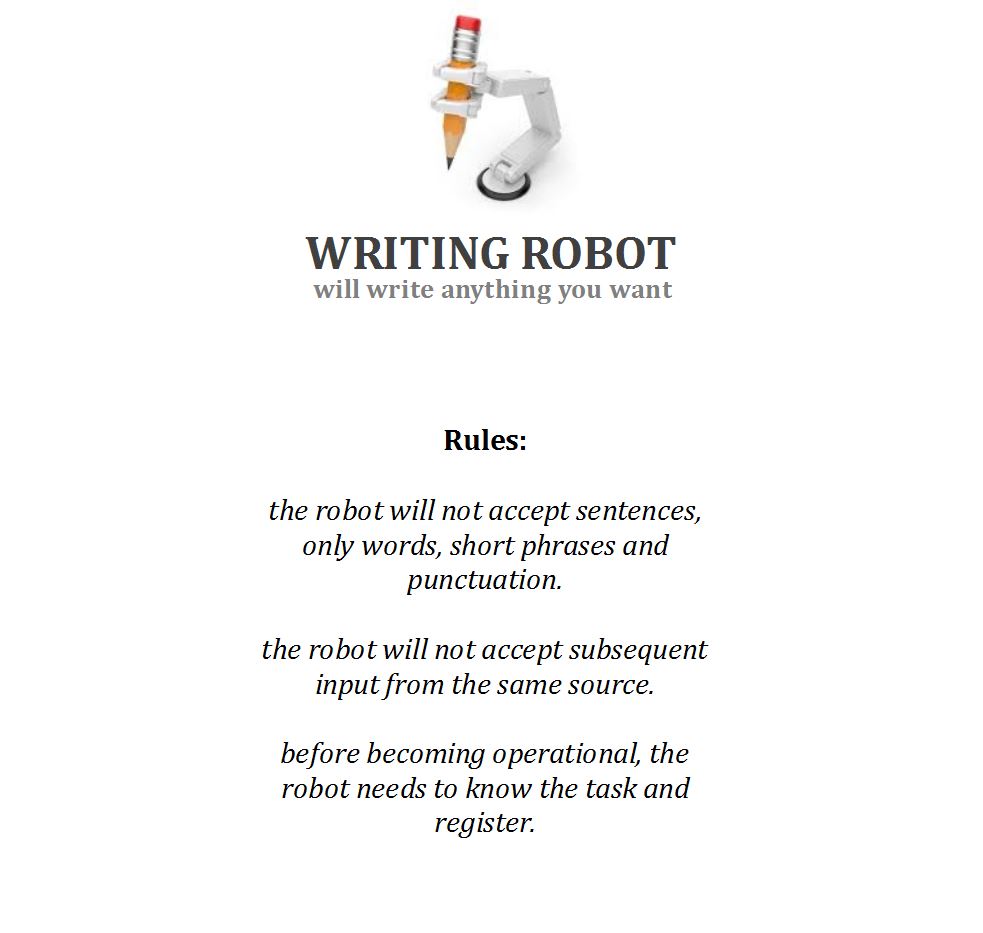
2016-09-25-11_44_42-activinspire-studio
I probably thought they needed a "box". Spontaneity here is more crucial. Something like this, and the rules in particular, should have been something the students came up with. Later on. Not the teacher. There should be no official "writing robot" frame around this activity until the students call for it. This is supposed to be an illegitimate game and not a scheduled lesson stage.
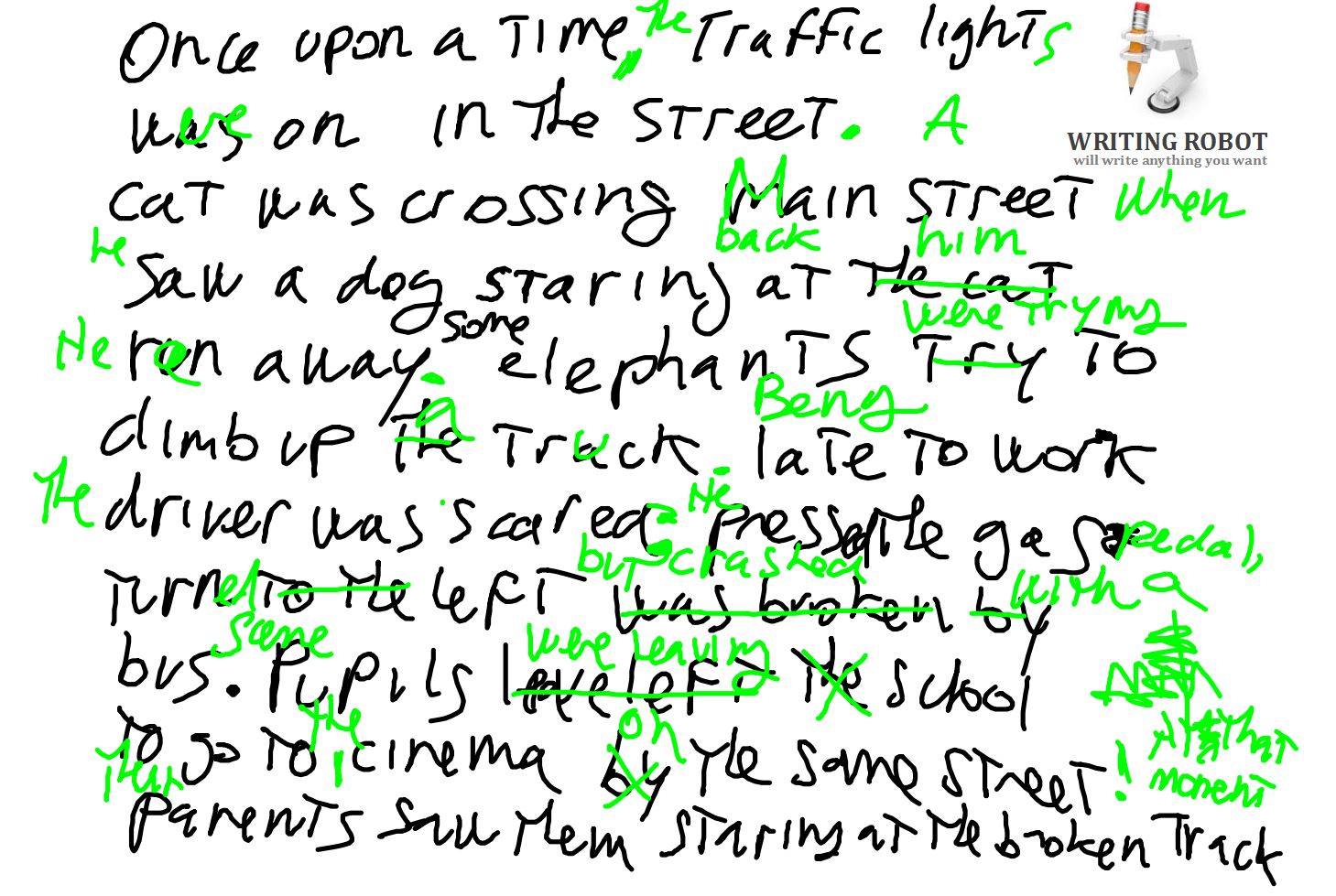
Here's the first story we wrote. I stood up next to the board behaving like a robot (lame) and faithfully printed all they suggested, going one by one:
 
2016-09-25-11_52_49-activinspire-studio
It went on for a few pages, then we did the error correction you can see in green. The story wasn't anything special and that should have rung a bell. Instead, I thought it was smart to translate this into a classic "Delayed Error Correction" moment. Which was a mistake as well. Like Johnstone suggests, much better would have been waiting for the students to be outraged by the errors themselves, demanding corrections:

I typed out everything exactly as they wrote it, including the spelling mistakes, until they caught me. Typing out spelling mistakes was a weird idea in the early fifties (and probably now)—but it worked. The pressure to get things right was coming from the children, not the teacher. I was amazed at the intensity of feeling and outrage the children expressed, and their determination to be correct because no one would have dreamt that they cared. Even the illiterates were getting their friends to spell out every word for them.
Keith Johnstone, Impro

 
Until then, I should have left the activity where it was, perhaps printed and posted on a wall.
The students played the "Writing Robot" a couple of times, with all the enthusiasm and animation they were capable of. Then, incredibly, after a serious consultation among themselves, they sent forward an envoy to make it clear with me that they didn't want to play the "Writing Robot" anymore. Please.
I asked why, and they said "it wasn't that much fun", and I let it go. But immediately, instinctively, I knew what had finally spoiled this activity for them: I was too pleased with it, me and my "romantic" teaching I told all about to my colleagues as if I had discovered gold, and the students could read it.
The creative efforts of my students were going in the direction of making me feel better, and that takes only so much of our energies before we give up.
I think this, this self-pleasing teaching, this "trying for the best", in search for admiration and praise is a common problem many teachers have, because of the frustrations the job lays upon you day by day, because of the pressure we are under and the insecurities that come with it. I can only be thankful to those kids who made me see it.
So I gave up, and never thought of doing the "Writing Robot" anymore, until now... now I would do things differently, and who knows how it might go.
close your eyes to the picture and listen.

Since I was recently writing about it, I thought of sharing more on the topic of "describing pictures".
It's an activity* I sometimes use in the context of PET preparation. It might work for FCE as well, though in that exam photos are compared, rather than described. Something awkward about which quite rightfully Alex Case comments:

"Comparing two photos on your own for (exactly) one minute has to be the most unrealistic, pointless and random speaking task of all time. In the rare moments when we do talk about photos in real life, we certainly never compare them. Outside Cambridge exams, I doubt more than 0.1% of the world population have ever done such a thing in their whole lives."

~ Alex Case, usingenglish.com

 
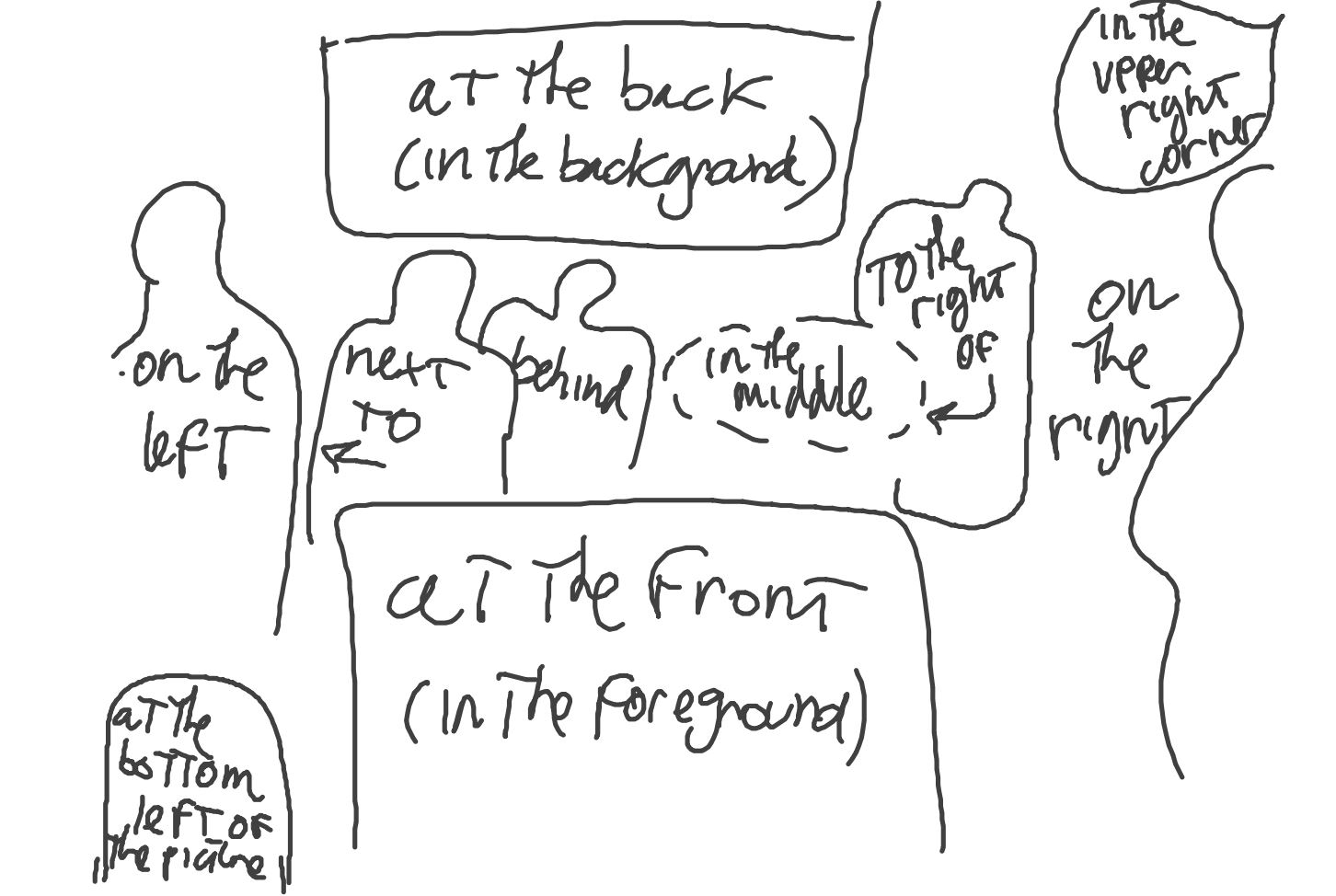
The requirement for this practice activity is that you, the teacher, have presented those useful expressions to identify, describe and point out objects, scenery and people in a picture: "at the back" "to the left" and so forth, plus the grammar that goes with it (essentially the present simple and continuous). Something that on your board might eventually look like this:
2016-09-24-16_02_20-activinspire-studio
Now you probably want to give a chance to the students to practice all of it, plus as much vocabulary as the images carry with them.
As to the preparation for the lesson plan, all you need are very basic, yet essential, "Google image skills". A projector or IWB are also needed. (Actually, none of this is "needed", but you know what I mean.)
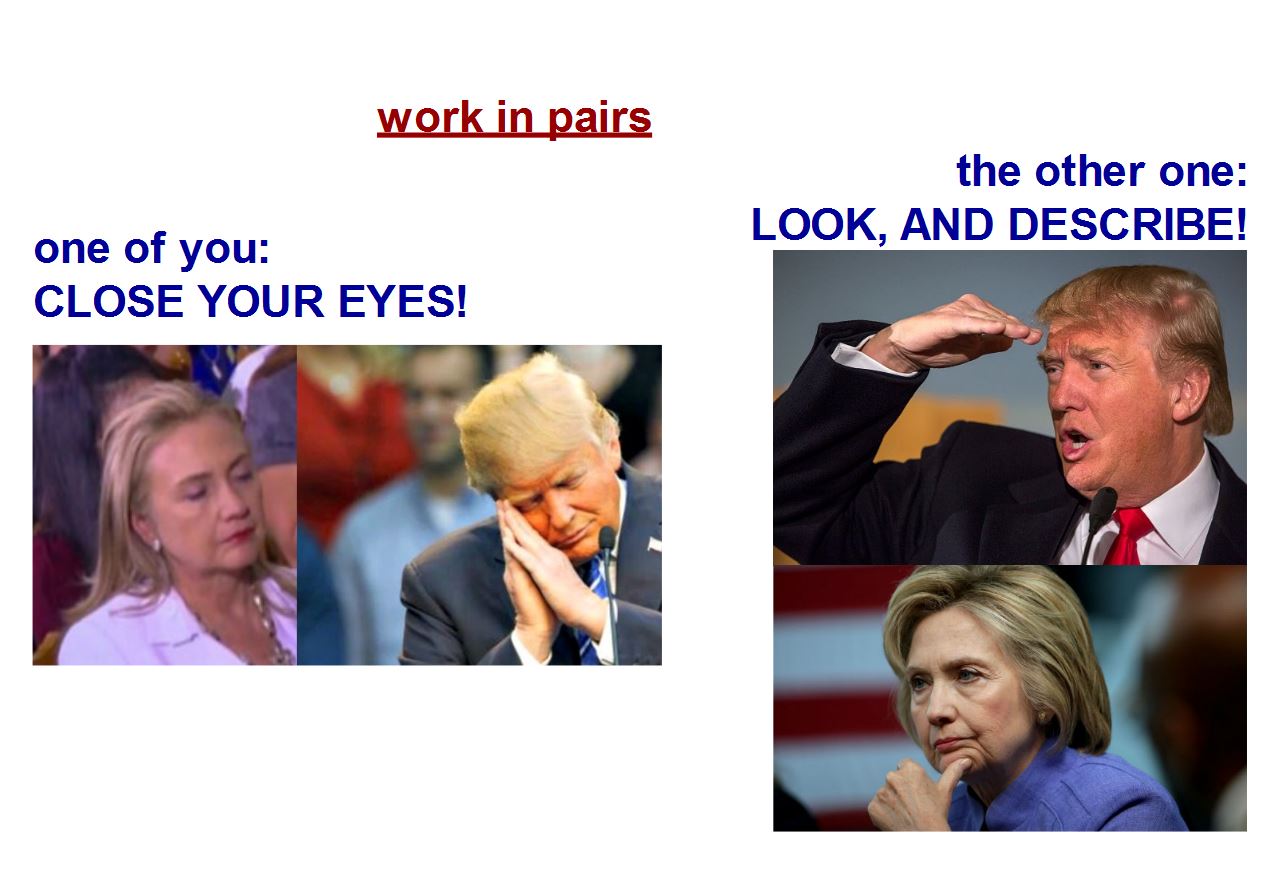
The class will be divided in pairs, or in groups of three. Just to introduce my simple instructions, I might show at first a picture like this one:
2016-09-24-14_48_16-activinspire-studio
(The above wise collage is certainly not necessary...! I had Prince Charles and Queen Elizabeth in a previous version - if you go for something like this naturally you will want to keep it updated to something which, while being current, will also attract your students' attention and raise at least an amused smirk.)
Alternatively to the closed eyes, the students who listen to the description could simply have their backs turned to the board. This might actually give your class more ease in focusing on the description and its content.
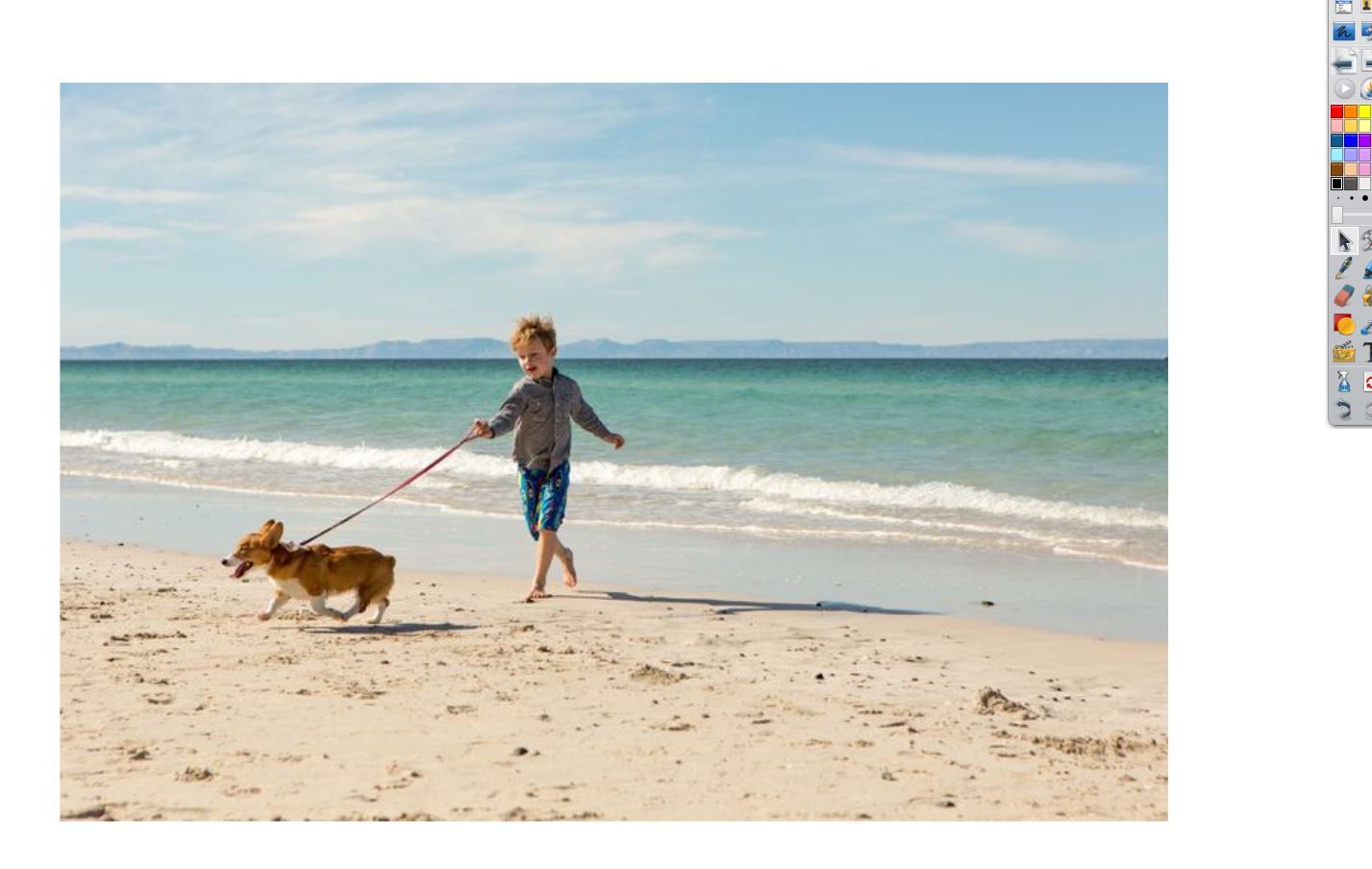
In any case, once you verify that there is only one student left in each group who can see the projected screen (and only then), turn to the next picture, which will be something you might have downloaded from Google. In this case the result of the Google search "child walking the dog on the beach":
2016-09-24-15_52_03-activinspire-studio
While in each group one student is describing it, the other ones try to visualize the picture in their mind. The above example is deliberately scarce in details, which makes it easier provided your students have the vocabulary they need. In this case: directions, clothes, the sand, the beach... They most certainly will not have the word 'leash', but will manage to paraphrase it nonetheless.
Generally speaking the choice of the picture is left to whatever you think is appropriate to raise interest or to challenge, shock or bother the students. Anything, essentially, they have words and enough motivation to describe.
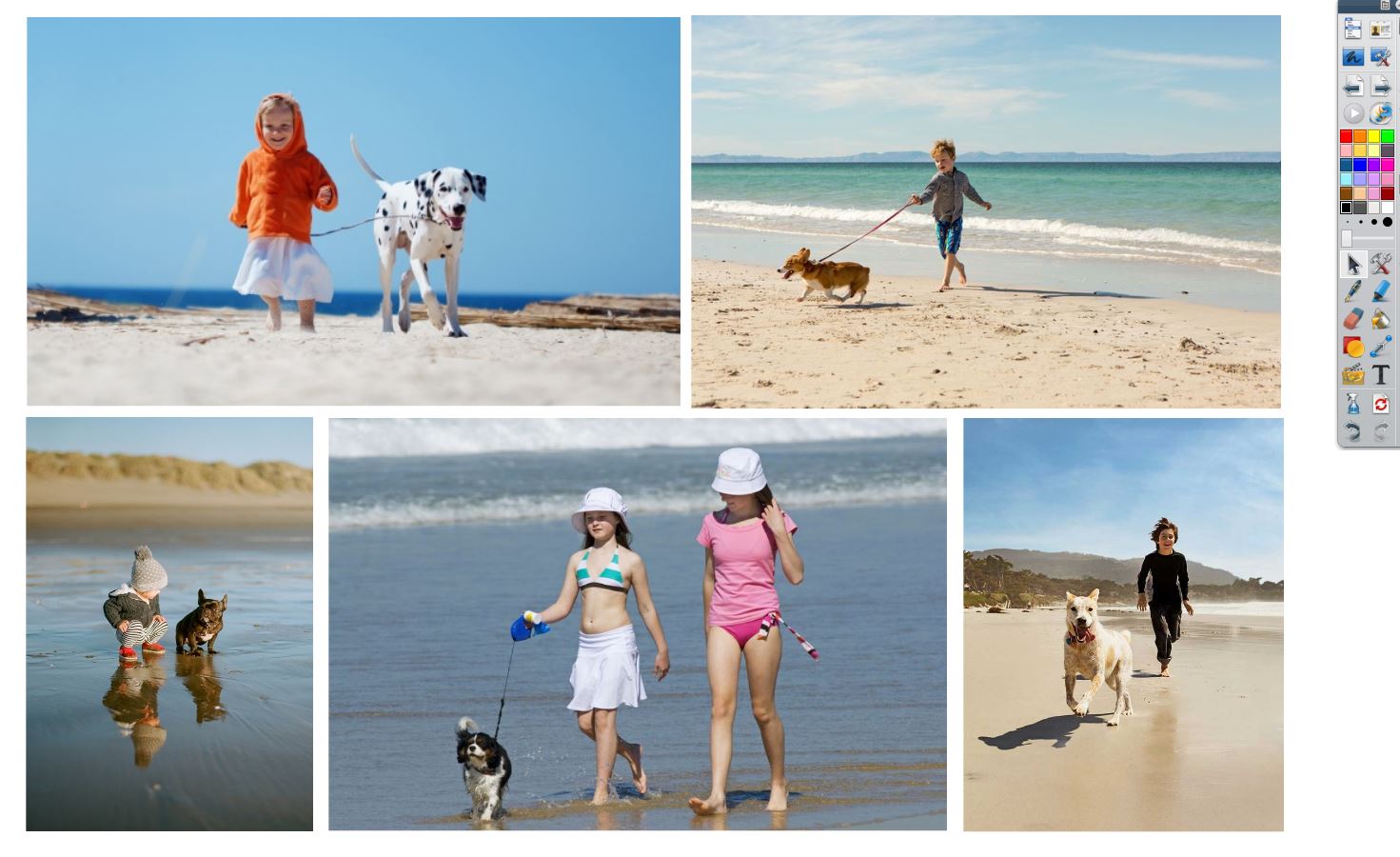
The description can go on for five-six minutes... Once you feel the students have exhausted the things to say, it is possible to stop them and turn to the next slide. Then (and only then) you give instructions to the other students to open their eyes, or turn around facing the screen, to look at this:
2016-09-24-15_57_11-activinspire-studio
As you can see this is a set of pictures (including the one that has been described) which are quite similar to each other (how similar is your choice  - more similar means more difficult).
The students who were not allowed to see the initial picture are at this point prompted to identify the picture that has just been described within the set.
Most of them will not find this very challenging, at least at first. The interesting thing about it is that, should they fail, this is most certainly because of language misuse. Definitely a good opportunity for the teacher to clarify uncertainties and correct mistakes, either on the spot (if crucial to the continuation of the activity) or during a delayed error correction.
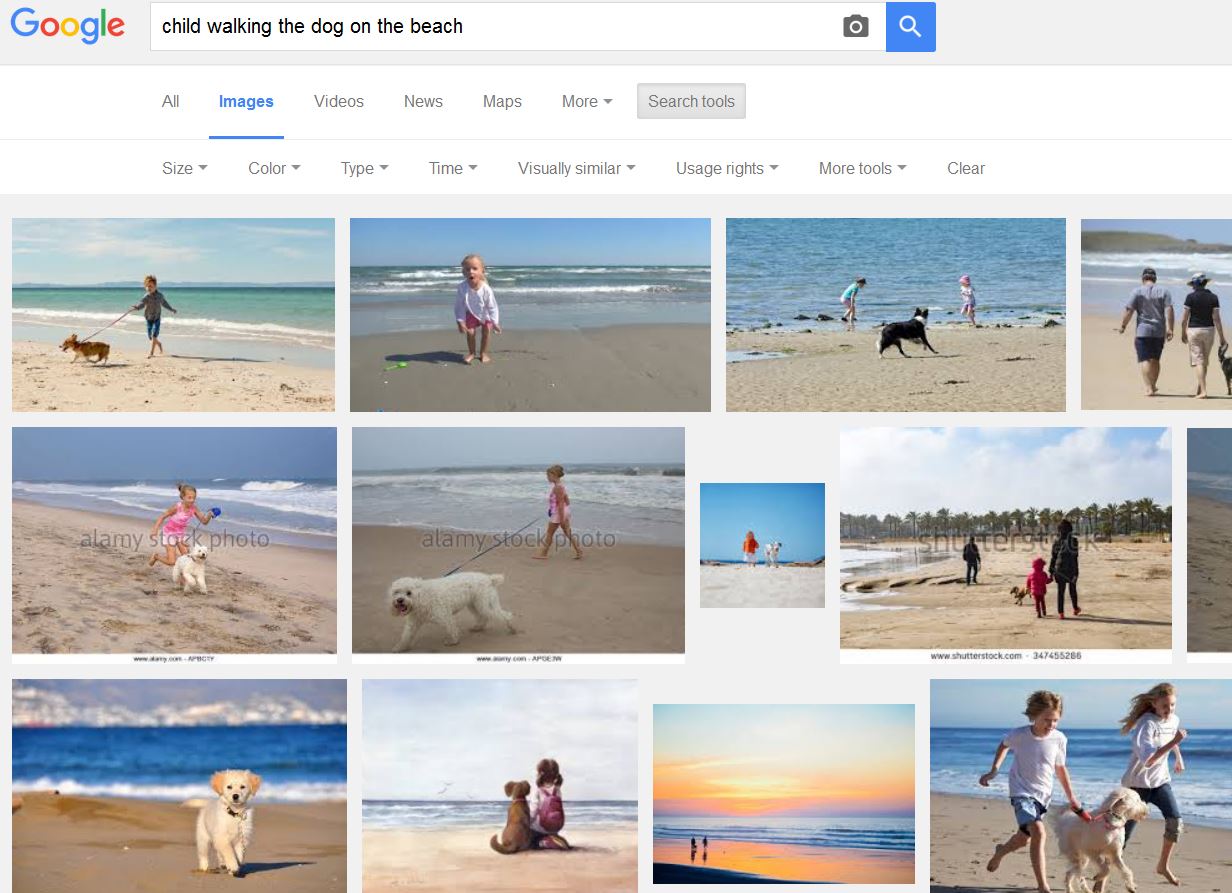
As to the source of such similar images, it's all done quite easily in Google. Here's how:

  1. On the Google images result page, drag your picture of choice up into the search form at the top of the page, and drop it there (this is called Google Image reverse search; it is a life saver and it is amazing how many people still ignore its existence);
  2. Click on the "visually similar images" link that will show up.

The results might look something like this:
2016-09-24-16_22_08-learn-and-work
With a bit of scroll up and down you are bound to find images very similar to each other -- and ideally suited for this teaching activity.
The practice goes on with more sets of pictures (giving a chance to everyone to be a describer or a listener) of increasing difficulty.
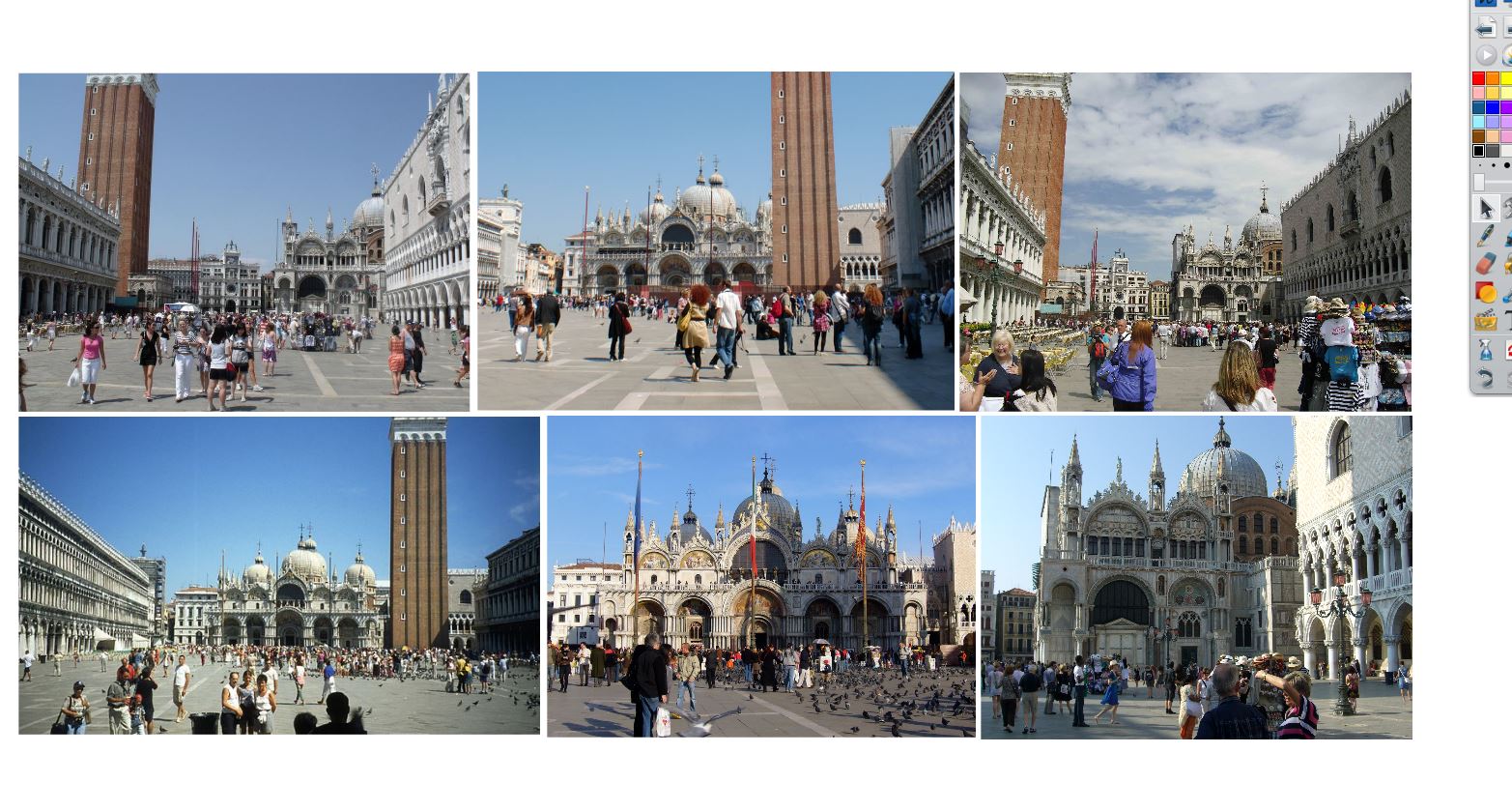
The last slide might require the students to identify one picture out of a set like this (also quite easily created from Google images, with a very quick search for "Piazza San Marco"):
2016-09-24-16_59_58-activinspire-studio
Here the "describers" need to be very detailed in their description; they need more vocabulary, and to have more imagination in the way they describe things. It is also much more challenging for the listeners, who have to visualize and remember a lot more.
This is about it, for this activity. As a follow up/cool down, you might want to ask the students to write down all the vocabulary they can recall from the various descriptions, and ask each other to add more to the list, and/or check the spelling.
I hope you will find this useful. If you are an "ActivInspire" user, you can download from here the demo of this lesson, which includes the slides shown above:
guess-the-picture.flipchart
As a bonus, here's a couple of variants for this activity:

  1. You show the full set of pictures directly to the describers, leaving to them the choice of which picture they want to describe. This is better (more freedom is always better), unless one or two of your pictures are really easy to identify.
  2. The listener will not sit there with their eyes closed. Instead, they will draw whatever is being described. You can prepare folded-up pieces of paper printed on the hidden side with the picture that is being described. At the end of the description the students can unfold the paper and have fun directly comparing the original image to the illustration of it they've just finished describing and drawing, pointing out differences and similarities.
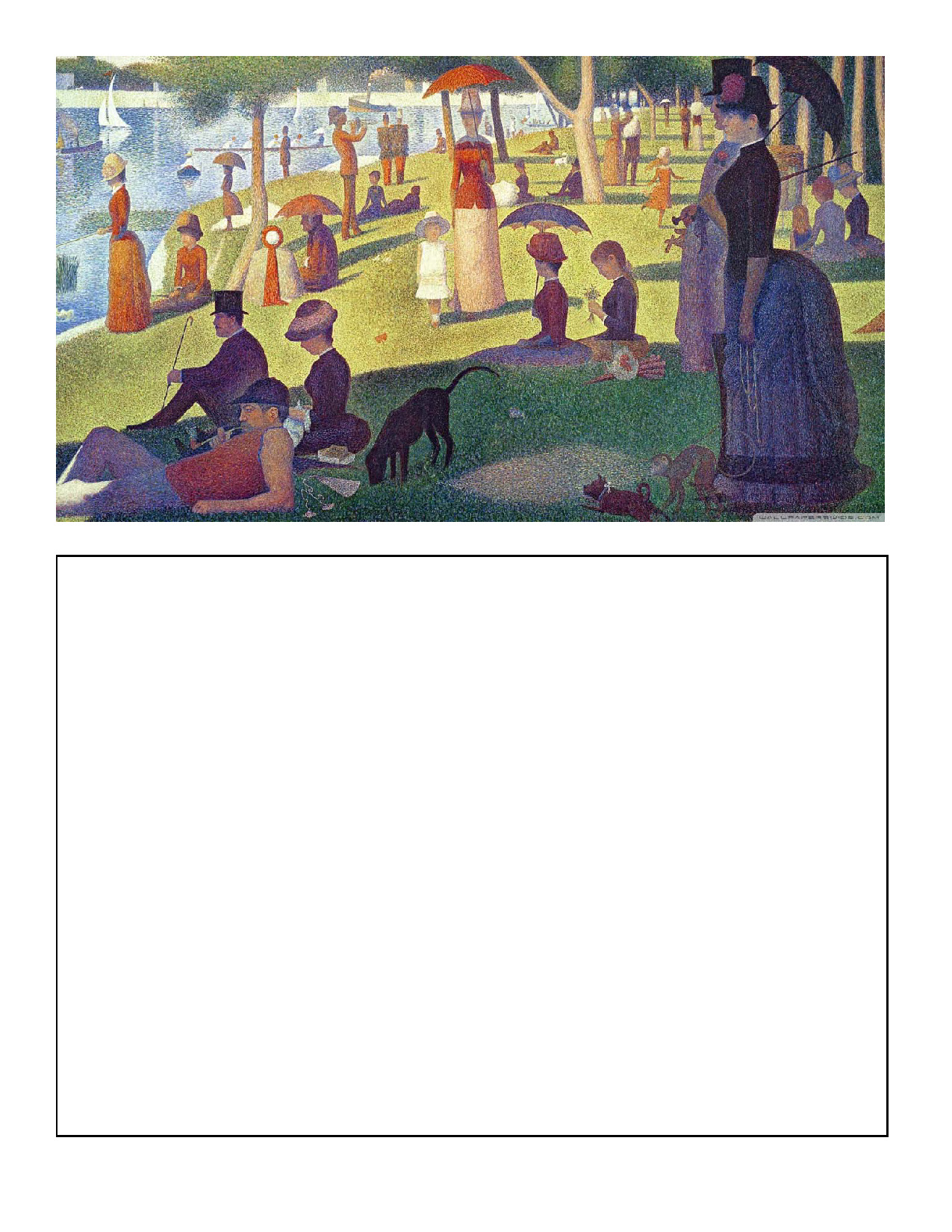
    I tried this several times using among other pictures "A Sunday Afternoon on the Island of La Grande Jatte" by Seurat. This was the fold-up page I would print:
    describe-and-draw_page_1
    The students would draw in the blank space (sadly I haven't digitized any of the samples from my lessons, all quite funny and some really artistic in their own way) and unfold it afterwards, revealing the actual painting by Seurat.
    In my experience a task like this never fails to entertain students, while bringing them to use a lot of pertinent language. In fact it stands on its own as a "describe-draw-chat" activity, without the further challenge of identifying the picture in a set.

* Needless to say, I haven't "invented" this activity! In fact I first heard about something like this during a Professional Development Day session at IH, from someone who had heard it in a course where a tutor had heard it from... well whoever thought of this before them is lost in the teaching sands of time, way back when Google didn't exist yet.

Do you like fish sticks? how we could use a totally inappropriate South Park joke in class

If we were allowed to use coarse language, inappropriate jokes and nonsensical or absurd comedy in class, this South Park episode would be ideal to give an example of the trickery of pronunciation and collision of words.
southpark-gayfish
It goes like this:
do you like /fɪʃtɪks/?
do you like putting /fɪʃtɪks/ in your mouth?
what are you, a gay fish?
The trick is all in that /t/ that ends up sounding a bit soft due to the rushed way in which we name and identify this particular product.
The above could serve as a jocular introduction to a couple of pronunciation games emphasizing how we really say words in English, and how these words are never in isolation but actually mashed together head to tail... something like the teacher reading out different pronunciations of different phrases, as the students match them to transcript; or teacher giving red and white squares of paper to be placed according to the stress in a phrase or sentence.
(of course, as wikipedia tell us, fish sticks are really fish fingers, as they were called when they were first invented in Britain. To which could follow a discussion on how some jokes can only be validated locally).
 

a big expenditure of children and a large consumption of elderly people, continued part two of my IELTS rant

[continued from the first part]
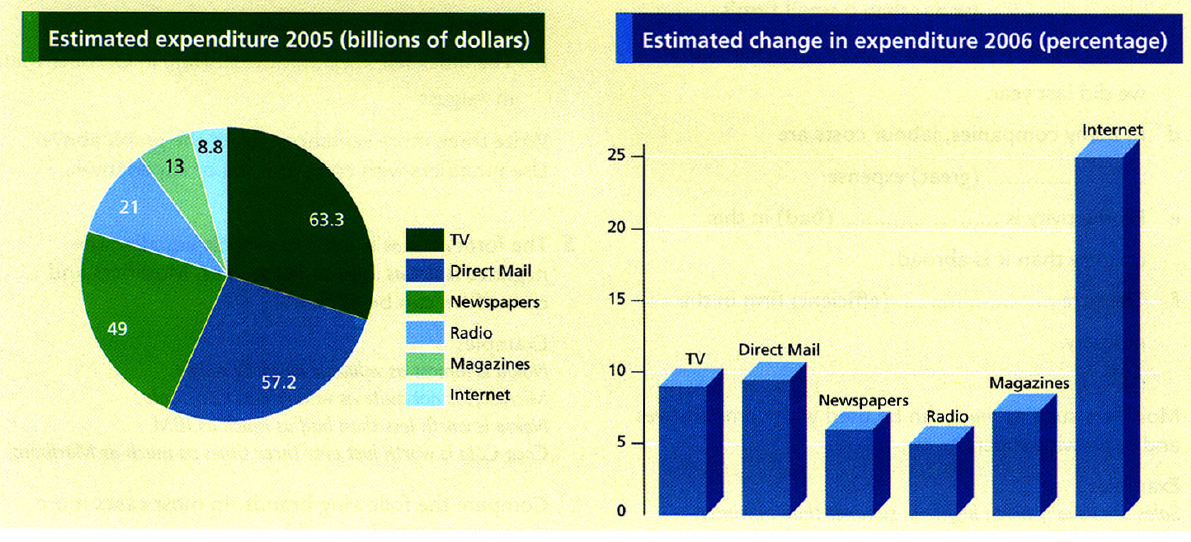
So one day we looked at this (from the book IELTS Masterclass):
charts
The charts illustrates spending on advertising across different media sources, so the emphasis was about numbers to express expenditure, proportions, preference, etc.
After a bit of vocabulary clarification, and a few sentence samples, the students were put into groups and given one of the charts, for which they had to provide the best possible written description. The groups were then mixed and the charts compared verbally. After a bit of feedback the students were given 12! minutes (not 20, because the thinking had already been done, and also because this class had the tendency to write too much) to actually write the task. So far so good, although of course they don't like this task. Nobody does. The results aren't exciting no matter how much craft you possess.
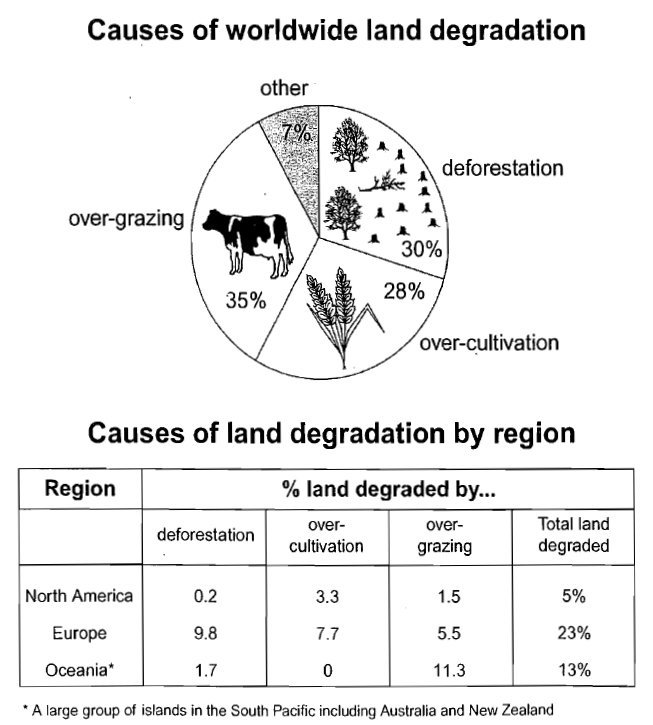
Another day, a different chart. This time from Cambridge IELTS 8:
charts2
We focused this time on consumption, degradation, eating habits, overuse etc.
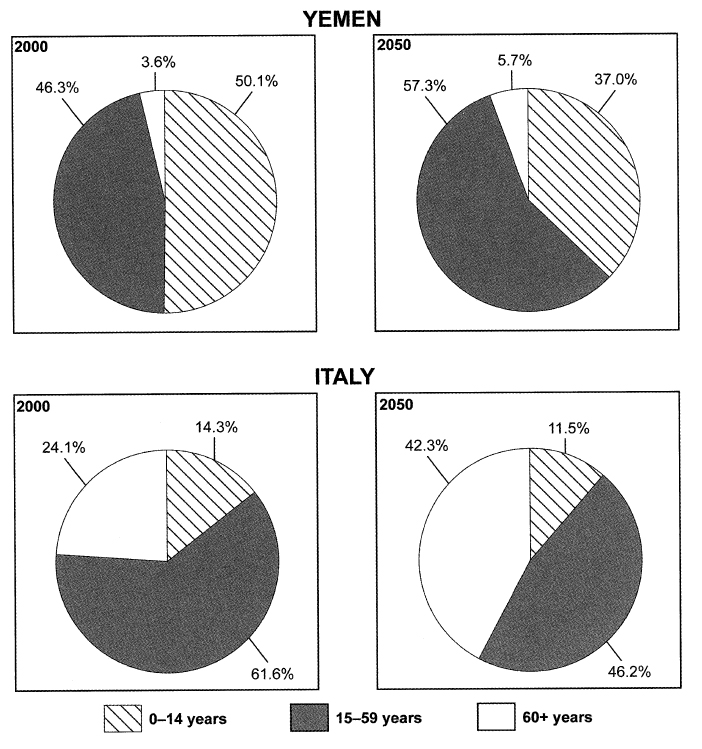
Another day, it was this set of charts, from IELTS 9:
charts3
Even without including the task instructions, it appears evident that these charts are describing age groups in two different countries. However, because we teach the IELTS exam, but we have no time to actually teach why charts such as these exist, when and how they are used etcetera, they are perceived by some students as mostly sadistic ways to test the students' understanding of numbers inside and around differently shaped graphs, despite the graphs actually having no meaning of their own.
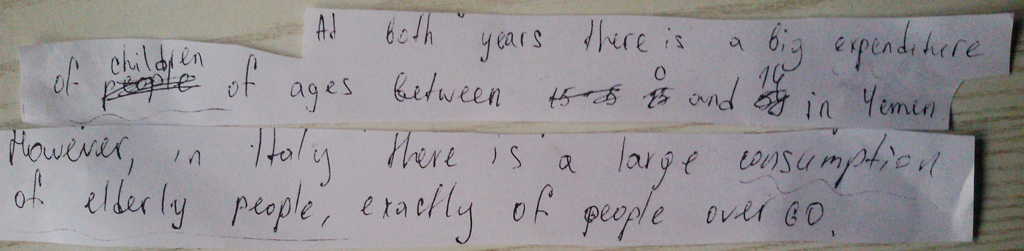
It is not always easy or obvious to make the students think differently, and the results can be sometimes discouraging or hilarious, depending on your outlook on that particular day. So this was the result after our time spent on writing task 1 (right from my locker where I keep the trophies):
expenditure2

a big expenditure of children and a large consumption of elderly people AKA my IELTS rant

Teaching IELTS rather than teaching English is ultimately a contradiction. This exam tests the level of English after all, and the student's ability to use it in a purposeful way; just learning the test format inside out seems to be a desperate, uncool way of cheating -- yet we make the whole experience into exactly this, a test about the test itself and our understanding of the different parts of the test and our feelings on the day of the test and this is how we pass the IELTS test, voilà.
Maybe this happens because the IELTS format is so eternally rigid and presents no surprises. It is a bit like working out, doing always the same sets everyday. Every trainer will tell you that this does not improve your fitness, because the muscles will do their best to save energy once they have memory of the tasks that await them: you've got to "fool" your muscles if you want them to become stronger. Feeling that your exercises come easier and easier is not a good thing either. Basically you're still weak, but you're in shape enough to do the exercise (that Senifeld bit coming to mind).
Especially the so called "IELTS Foundation" class is a bit of a joke, its only purpose being the business need to catch delusional students who otherwise would roam towards other schools. There shouldn't be an IELTS Foundation class. Instead, the hopes of the students should be crushed for their own good, and they should be sent to a good General English class to do some time. Although, the class has a purpose for the student too, because at that stage they usually need someone to blame for not entering that University, and your local English school will just do.
Of course it's crucial for the students to know how the exam works, but as a teacher you cannot help but feeling that this should happen within a larger context where English learning and exposure to English culture are the real focus of your time with the students. More importantly, there should be a context in where students learn to use their imagination critically. Soon they will face an examiner and will have to discuss intelligently how the Internet has changed relationships, or what role will pets play in the future; why people cannot stop using cars or why food is the last remaining bit of national culture left, which is why we are all so ridiculously attached to it. That subconscious, instantaneous, defensive answer "what do I know, I'm barely out of High School" will most definitely not cut it.
Instead even your average IELTS "Masterclass" group (no name was more inappropriate, since it gives the student the illusion of being part of a specially selected bunch of next-to-be IELTS wizards) is made of students with little or no experience in using English in real life, let alone in an academic context, who only have two or three months to get into that University and have exactly the right amount of desperation to get their thinking all fogged.
The web is full of tips and a large industry of book publishing thrives on this. Yet the so called "exam techniques" are often very arbitrary in that they focus on aspects that can be obvious for one student, unheard of for another, and which can seriously hinder candidates who have their own personal or even creative way of looking at a task. Sometimes they are offensively disingenuous, for example when they pretend to teach the student how to "listen for the answer" in an IELTS listening by considering the stress, or the appearance of certain keywords. A confusing waste of time.
What will you teach them then, in those three "intensive" months?
What you do, once they are familiarized with the format, is for the most part to give them vocabulary sets and interesting ways to practice them, help them to organize their writing and speech and, ultimately, do quite a bit of IELTS practice in class, since you know they will not do it at home as they should. No, there will be no Eureka moment to look forward to.
It's not the best premise for good teaching. However as a teacher you do it and of course, as with everything, useful things can come out of it. Which brings me to the title of this IELTS post.
[continues in the second part]
 

“what will I teach today?”
an ESL blog by
© 2026